So far, the extra pushup practice has paid off a bit. I improved from 3 reps/set in the pushups on my Above The Rings days to 5 reps/set. I was able to do 6 reps/set on my Below The Rings days because my triceps had not been worked by doing dips.
Today was my last Below The Rings day in Phase 1. The Rings One program schedule says I should begin Phase 2 next week. However, the manual says I should not adhere strictly to the schedule. If I'm not comfortable, I am free to stay in my current Phase for as long as it takes, before advancing to the next Phase. I watched the training videos for Level A, Phase 2. I'm confident I can start on the Above The Rings portion of Phase 2, because I feel I can handle all three exercises. I already do Dips and have done Top Position Tuck Sit holds in the past. I think I can handle the Assisted Tuck to Shoulder Stand.
What I wasn't sure about was the Below The Rings portion, which is also composed of three exercises: Pullups, Inverted Tuck Roll Chins, and Skin The Cat. I'm doing pull-ups for reps now so I'm fine with that exercise. It's the latter two I was worried about, so when I got home, I tried those two for the first time. I did one rep of the Inverted Tuck Roll Chin without any problem and could have done more. This was a pleasant surprise because of my struggles to execute the Jump to Tuck to Inverted Hang, which is the prerequisite to this exercise. The Skin The Cat I was most worried about because I'd never done this move before, and I've had a previous injury to one of my shoulders. This looked like a move that could pose some serious trouble to my shoulders if I mess up. On my first couple of attempts, just as I'd anticipated, from the inverted hang position, I struggled to lower myself into the German Hang (the finishing position of Skin The Cat), because of the fear of injuring my shoulders. Fortunately, I'd set the rings at a relatively low height so if anything went wrong, all I had to do was extend my legs and stand up on the floor. I started to conquer my fear by extending one leg and letting a toe touch the floor, then tucking it back and extending the other leg. Finally, I was able to lower myself into the German Hang with my legs tucked so that the feet wouldn't touch the floor. I was also able to pull my body back out of the German hang into the inverted hang. Success! I watched the training video again and noticed that unlike the Crossfit style, the Skin The Cat just starts and stops in Inverted Hang, at least for Level A, Phase 2.
Another thing that helped me get comfortable with the German hang was GMB's update of Rings One - specifically the Warmup routine. They added shoulder mobility movements in which you use a towel or similar cloth item to stretch your shoulders, and two of those movements move your arms in and out of the German hang (or where they would be if you were hanging in that position).
Regarding the Levels, Rings One is actually presented in two levels - A and B. Level A is for those new to ring training and Level B is for those who have previous experience or are just too strong to get any benefit out of Level A. I took a peek at Level B, Phase 1 and quickly determined it was too difficult for me. My strength is somewhere between Level A and Level B at Phase 1, and just right for Level A, Phase 2.
Part 2 will be the report of my final workout for Phase 1, which is my last Above The Rings session i this Phase.
Wednesday, March 18, 2015


Friday, March 13, 2015
Rings One Week 4 Report
This week, I changed up my Below The Rings day routine to look like this:
Pullups 3 sets
Tuck To Inverted Hang 5 sets
Pushups 3 sets
I do the most sets on the movement I'm weakest at in the "below rings' category, which is the Tuck to Inverted Hang. The pushups don't belong in this category, but I need the extra practice. Unfortunately, I was unable to duplicate my performance of the Tuck to Inverted Hang from Wednesday of last week, in which I nailed two perfect reps of the movement. Still too much swinging and lack of coordination between the pulling action of the arms and the raising of the hips via the "knees to armpits" action.
One idea that occurred to me today while walking home was to try 3 sets of 3-5 sec. of what I call a "flex-arm tuck lever". This is what a legit tuck lever looks like, courtesy of the excellent Beast Skills lesson on the Front Lever:

Of course, I'm following the Rings One program, which has a very different way of working up to a Front Lever, but what I call the "Flexed Arm Tuck Lever" is a lot like the Tuck Lever, except with the arms flexed. The Beast Skills lesson mentions that the trick to get into the Tuck Lever, if you're struggling to do it, is to lower yourself into it. I found one way is to just do a pull-up and tuck your knees as shown above, then lower yourself by straightening your arms with your knees still tucked. The Flexed Arm Tuck Lever is just the position you would be in if your did not lower yourself - your arms are flexed from doing the pull-up. The Flexed Arm Tuck Lever may not exactly be the middle position between the pull-up and the inverted hang position of the Jump Tuck to Inverted Hang move, but I suspect working in some holds in the Flexed Arm Tuck Lever will help me gain the strength I need to better control the movement.
Not much progress to report on the Above The Rings days. For next week, I'm thinking of just doing full-range pushups on those days instead of partial range, with the understanding my reps will be lower on the Above The Rings days due to the triceps being taxed from doing dips.
I managed to do 5 sets of Leg Module Level 1 on Tuesday, and 4 sets on Thursday.
This evening I was struck by intense hunger pangs. I'd never experienced this much pain before from just being hungry. I was also bloated with gas and having to burp a lot to try to release some. I don't believe I ate anything all that unusual. Breakfast was scrambled eggs w/ cheese, and potatoes. Lunch was salad - mixed spring greens, chicken slices, boiled egg slices, beets, broccoli, edamame beans, artichokes - and an Italian soup of ravioli, tomato, and sausage. I'd experienced the feeling of hunger before but not like this. I'd already made plans to go grocery shopping, so when I arrived at Whole Foods, I gladly purchased a $7 Nepalese dinner plate with chicken, a potato-and-cauliflower dish, rice and two dumplings and wolfed it all down as if I'd been starved for weeks. I was still hungry afterwards and so bought more Nepalese chicken dumplings. Was this intense hunger due to my body wanting to build muscle after what thought was a moderate amount of exercise? We'll see.
Pullups 3 sets
Tuck To Inverted Hang 5 sets
Pushups 3 sets
I do the most sets on the movement I'm weakest at in the "below rings' category, which is the Tuck to Inverted Hang. The pushups don't belong in this category, but I need the extra practice. Unfortunately, I was unable to duplicate my performance of the Tuck to Inverted Hang from Wednesday of last week, in which I nailed two perfect reps of the movement. Still too much swinging and lack of coordination between the pulling action of the arms and the raising of the hips via the "knees to armpits" action.
One idea that occurred to me today while walking home was to try 3 sets of 3-5 sec. of what I call a "flex-arm tuck lever". This is what a legit tuck lever looks like, courtesy of the excellent Beast Skills lesson on the Front Lever:
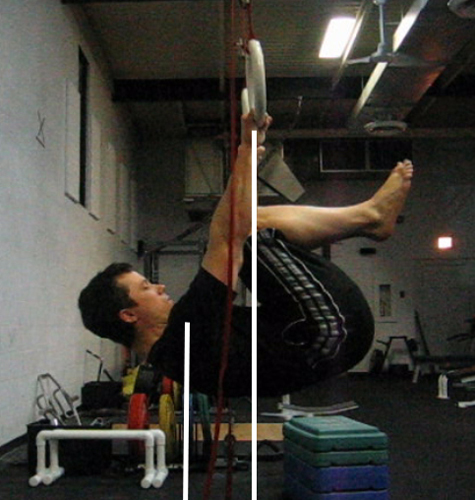
Of course, I'm following the Rings One program, which has a very different way of working up to a Front Lever, but what I call the "Flexed Arm Tuck Lever" is a lot like the Tuck Lever, except with the arms flexed. The Beast Skills lesson mentions that the trick to get into the Tuck Lever, if you're struggling to do it, is to lower yourself into it. I found one way is to just do a pull-up and tuck your knees as shown above, then lower yourself by straightening your arms with your knees still tucked. The Flexed Arm Tuck Lever is just the position you would be in if your did not lower yourself - your arms are flexed from doing the pull-up. The Flexed Arm Tuck Lever may not exactly be the middle position between the pull-up and the inverted hang position of the Jump Tuck to Inverted Hang move, but I suspect working in some holds in the Flexed Arm Tuck Lever will help me gain the strength I need to better control the movement.
Not much progress to report on the Above The Rings days. For next week, I'm thinking of just doing full-range pushups on those days instead of partial range, with the understanding my reps will be lower on the Above The Rings days due to the triceps being taxed from doing dips.
I managed to do 5 sets of Leg Module Level 1 on Tuesday, and 4 sets on Thursday.
This evening I was struck by intense hunger pangs. I'd never experienced this much pain before from just being hungry. I was also bloated with gas and having to burp a lot to try to release some. I don't believe I ate anything all that unusual. Breakfast was scrambled eggs w/ cheese, and potatoes. Lunch was salad - mixed spring greens, chicken slices, boiled egg slices, beets, broccoli, edamame beans, artichokes - and an Italian soup of ravioli, tomato, and sausage. I'd experienced the feeling of hunger before but not like this. I'd already made plans to go grocery shopping, so when I arrived at Whole Foods, I gladly purchased a $7 Nepalese dinner plate with chicken, a potato-and-cauliflower dish, rice and two dumplings and wolfed it all down as if I'd been starved for weeks. I was still hungry afterwards and so bought more Nepalese chicken dumplings. Was this intense hunger due to my body wanting to build muscle after what thought was a moderate amount of exercise? We'll see.
Friday, March 06, 2015
Rings One Week 3 Report
Took a look ahead in the schedule and saw that I have only two more weeks to go in Phase 1, Beginner. I'm ahead of schedule in that I can do pull-ups and dips unassisted. I continue to make progress with the pull-ups and dips. But I'm behind schedule with the pushups and the tuck to inverted hang. Looks like I should do the max recommended number of sets (5) of pushups and tuck to inverted hang since those are my weakest moves. I continue to substitute partial range pushups (full pushup position, no knee support) for assisted pushups (from the knees) because its actually easier on my left shoulder.
Phase 2 Beginner progresses from assisted pushups, mountain climbers, and plank holds to the Tuck to Shoulder Stand. The first time I worked with Rings One, I found this to be a huge jump in difficulty level. I must not have been the only one to complain about this abrupt jump in difficulty because the good folks at GMB eventually published an article on how to prepare for the Tuck to Tuck Shoulder Stand. Later, they updated the Rings One program itself and now I see an exercise called Assisted Tuck to Tuck Shoulder Stand in place of the full movement for the first couple of weeks of Phase 2. Maybe they found that for some people, simply lowering the rings and using foot assistance was more effective than the program described in the article. I'll see what happens when I get to the end of Phase 1. I may have to incorporate the article program into a Phase 1.5, depending on what happens on my first attempt at the assisted version of this movement.
On the below-the-rings side, Phase 2 progresses from Tuck to Inverted Hang to a rolling movement in which you roll back and forth between the inverted tuck hang position to the top of a chin-up. I may have a better chance of pulling (no pun intended) this off on first try because my stability in the Tuck to Inverted Hang improved considerably this week.
I did one Leg Module workout on Tuesday. I was going to attempt another one Thursday but then the snowstorm came so I decided to save my energy and legs for shoveling snow. I might do one tomorrow.
Oh, and I found that I gained 5 lbs since the start of Phase 1.
Phase 2 Beginner progresses from assisted pushups, mountain climbers, and plank holds to the Tuck to Shoulder Stand. The first time I worked with Rings One, I found this to be a huge jump in difficulty level. I must not have been the only one to complain about this abrupt jump in difficulty because the good folks at GMB eventually published an article on how to prepare for the Tuck to Tuck Shoulder Stand. Later, they updated the Rings One program itself and now I see an exercise called Assisted Tuck to Tuck Shoulder Stand in place of the full movement for the first couple of weeks of Phase 2. Maybe they found that for some people, simply lowering the rings and using foot assistance was more effective than the program described in the article. I'll see what happens when I get to the end of Phase 1. I may have to incorporate the article program into a Phase 1.5, depending on what happens on my first attempt at the assisted version of this movement.
On the below-the-rings side, Phase 2 progresses from Tuck to Inverted Hang to a rolling movement in which you roll back and forth between the inverted tuck hang position to the top of a chin-up. I may have a better chance of pulling (no pun intended) this off on first try because my stability in the Tuck to Inverted Hang improved considerably this week.
I did one Leg Module workout on Tuesday. I was going to attempt another one Thursday but then the snowstorm came so I decided to save my energy and legs for shoveling snow. I might do one tomorrow.
Oh, and I found that I gained 5 lbs since the start of Phase 1.
Wednesday, March 04, 2015
Jump To Inverted Hang observation
The Jump to Inverted Hang movement has been a challenge for me, because I'd struggled to execute it without excessive swinging. Less swinging and better body control is needed to progress to the next movement, which is the Inverted TuckRoll Chinup.
Towards the end of today's Rings One session, I was able to execute the movement with better control and almost zero swing of the rings. What seems to be key is the coordination of the pull on the rings with the drive of the knees towards the armpits. I seemed to either pull on the rings while forgetting to drive the knees to the armpits, or drive the knees to the armpits while forgetting to pull. With the right coordination I feel a lot more in control and the unwanted swinging is eliminated.
Towards the end of today's Rings One session, I was able to execute the movement with better control and almost zero swing of the rings. What seems to be key is the coordination of the pull on the rings with the drive of the knees towards the armpits. I seemed to either pull on the rings while forgetting to drive the knees to the armpits, or drive the knees to the armpits while forgetting to pull. With the right coordination I feel a lot more in control and the unwanted swinging is eliminated.
Friday, February 27, 2015
Rings One Week 2 Report
I completed Week 2 of the lowest-level Rings One program today.
For the Above The Rings days, I gave up on the Assisted Push-Up because something about the angle irritates my left shoulder. Full pushups are fine as long as I do partial pushups - the shoulder irritation begins when it is lowered within a certain distance of the rings. Back when I was seeing a physical therapist for my shoulder, one of the rehab exercises I did was partial pushups against a wall - so this is kind of the same thing, but with more resistance due to the instability of the rings. I'll try partial movement pushups for the next several workouts and see how it goes. Tuck Dips seem to be going fine - improved from 3 reps/set to 4 reps/set. The updated Rings One instructional video for the Plank Hold mentions "Hollow Body" as one of the key points, but otherwise there's no verbal explanation in the video. GMB does mention the Hollow Body Plank Hold and a separate instructional video for it here, and also has a link to the Hollow Body exercise that is done on the back instead of in pushup position. Thus, it's possible my Plank Hold could use some technique improvement. Technique is getting a bit better with the Mountain Climbers, though the reps have not gone up, due to my arms being a bit worn from doing the Tuck Dips.
For the Below The Rings days, I realized I could probably increase the volume (sets x reps). By replacing the assisted pull-ups, reverse rows, and negative pull-ups with regular pull-ups, I basically cut the session down to just two exercises - the pull-ups and the Tuck to Inverted Hang. Despite the inadvertently reduced volume, I still improved from barely doing 5 pull-ups to being ready to do 6 pull-ups per set. My Tuck To Inverted Hang reps were sloppy with lots of unwanted swinging. Today though I believe I solved the issue. It seems that I need to engage the pull-up muscles to do the move with proper control, or at least less swinging. What I was doing before was just pulling with the arms and trying to swing my knees and hips up, which was hit and miss. So now I start the movement with my arms fully extended overhead, as if I were about to do a pull-up, and my legs bent as necessary so that my torso and arms are straight. I initiate the movement with a pull, as if I were doing a pull-up, while simultaneously pushing off with the legs to facilitate tucking the knees. With more of the back muscles engaged in addition to the arms, I have much more control over the movement, and am more likely to be able to extend my legs out of the tuck into the inverted hang without having to use my feet to steady my body. This is much more taxing than the haphazard technique I was previously using, but feels more right.
This was the first week in which I did two Leg Module sessions. The Leg Module manual presents 3 different ways to schedule the Leg Module training along with Rings One or Parallels One training, but the program charts document simply shows optional Leg Module days on Tuesdays, Thursdays, and the weekend. At any rate, I did 4 circuits of Level 1 on Tuesday, and 4 circuits again on Thursday. Today, I have quite a bit of soreness in the legs, especially near the glutes.
For the Above The Rings days, I gave up on the Assisted Push-Up because something about the angle irritates my left shoulder. Full pushups are fine as long as I do partial pushups - the shoulder irritation begins when it is lowered within a certain distance of the rings. Back when I was seeing a physical therapist for my shoulder, one of the rehab exercises I did was partial pushups against a wall - so this is kind of the same thing, but with more resistance due to the instability of the rings. I'll try partial movement pushups for the next several workouts and see how it goes. Tuck Dips seem to be going fine - improved from 3 reps/set to 4 reps/set. The updated Rings One instructional video for the Plank Hold mentions "Hollow Body" as one of the key points, but otherwise there's no verbal explanation in the video. GMB does mention the Hollow Body Plank Hold and a separate instructional video for it here, and also has a link to the Hollow Body exercise that is done on the back instead of in pushup position. Thus, it's possible my Plank Hold could use some technique improvement. Technique is getting a bit better with the Mountain Climbers, though the reps have not gone up, due to my arms being a bit worn from doing the Tuck Dips.
For the Below The Rings days, I realized I could probably increase the volume (sets x reps). By replacing the assisted pull-ups, reverse rows, and negative pull-ups with regular pull-ups, I basically cut the session down to just two exercises - the pull-ups and the Tuck to Inverted Hang. Despite the inadvertently reduced volume, I still improved from barely doing 5 pull-ups to being ready to do 6 pull-ups per set. My Tuck To Inverted Hang reps were sloppy with lots of unwanted swinging. Today though I believe I solved the issue. It seems that I need to engage the pull-up muscles to do the move with proper control, or at least less swinging. What I was doing before was just pulling with the arms and trying to swing my knees and hips up, which was hit and miss. So now I start the movement with my arms fully extended overhead, as if I were about to do a pull-up, and my legs bent as necessary so that my torso and arms are straight. I initiate the movement with a pull, as if I were doing a pull-up, while simultaneously pushing off with the legs to facilitate tucking the knees. With more of the back muscles engaged in addition to the arms, I have much more control over the movement, and am more likely to be able to extend my legs out of the tuck into the inverted hang without having to use my feet to steady my body. This is much more taxing than the haphazard technique I was previously using, but feels more right.
This was the first week in which I did two Leg Module sessions. The Leg Module manual presents 3 different ways to schedule the Leg Module training along with Rings One or Parallels One training, but the program charts document simply shows optional Leg Module days on Tuesdays, Thursdays, and the weekend. At any rate, I did 4 circuits of Level 1 on Tuesday, and 4 circuits again on Thursday. Today, I have quite a bit of soreness in the legs, especially near the glutes.
Wednesday, February 18, 2015
Starting over with Rings One
This week, I began training with the Rings One program. In this older post I'd reported that I quit Rings One because I was unable to progress from pushups to Tuck Up To Shoulder Stand.
In the intervening time, GMB updated Rings One. There is now an intermediate skill to practice and master before attempting a Tuck Up To Shoulder Stand, as well as other refinements/revisions over the earlier version of the program. The program now also says don't worry if you can't do the recommended number of reps for an exercise. For example, if you can't do a minimum of 8 mountain climbers, it's ok - just do what you can and log what you did, along with the RPE (Rating of Perceived Effort) and RPT (Rating of Perceived Technique) scores for that workout. Yet another noticeable change is in the warmup routine - now it includes warmups for the hips, hamstrings and lower back.
Also during this intervening time, I was training with GMB's free Ultimate Guide To Ring Training program. I progressed from a max 4 pull-ups to 11 pull-ups, 0 ring pushups to a max 8 pushups, and 5-7 sec. tuck sit holds with one leg extended. I also played around with club bells, kettle bells, and Ultimate Sandbag.
So this week, I'm back to Phase A, Level 1 again in Rings One. For some people, pullups, pushups, and dips are actually not the easiest exercises to do on the rings. This phase of the program is concerned with developing the foundational strength to do those moves, among others. One significant change for this phase from the older version is that the Top Position Hold is now to be done with rings out, which is quite a bit harder than rings parallel to the body, but probably necessary for better prep for other moves that come out of that position like dips. Because I can already do ring pushups and pull-ups, I'm substituting those in my workout for the exercises that develop strength for pushups and pull-ups. I may also substitute what I call the Tuck Dip (the Dip as taught in the older version of Rings One, with the knees tucked) for the Assisted Dip, depending on how blasted I feel after the Top Position Holds. So far my shoulders seem to be holding up fine. My lats and triceps have been sore for several days because they haven't had this kind of demand imposed on them for a while. I was pleased to find that I could still to Tuck To Inverted Hangs - its actually easier when I don't jump into the tuck and focus more on the coordination of pulling with the arms and moving my knees towards my armpits.
The full manual for Rings One has several suggestions for integrating the optional Leg Module with Rings One. I'm just following the exercise charts, which schedules the Leg Module exercises on Tuesdays and Thursdays. I played with the Leg Module last week before "officially" beginning the program this week - it is indeed harder on the legs than it looks on the surface. I couldn't even make it to a 5th circuit. The only problem move with in this program is the lunge, because I have a weird tightness/pain sensitivity in my left foot that flares up when I put weight on my left toes, as I step forward with my right foot. The left foot seems to loosen up though as the sets pile up. Wearing my new running shoes with arch support seems to help a lot - I can get into pushup position without any pain on my left toes/foot.
In the intervening time, GMB updated Rings One. There is now an intermediate skill to practice and master before attempting a Tuck Up To Shoulder Stand, as well as other refinements/revisions over the earlier version of the program. The program now also says don't worry if you can't do the recommended number of reps for an exercise. For example, if you can't do a minimum of 8 mountain climbers, it's ok - just do what you can and log what you did, along with the RPE (Rating of Perceived Effort) and RPT (Rating of Perceived Technique) scores for that workout. Yet another noticeable change is in the warmup routine - now it includes warmups for the hips, hamstrings and lower back.
Also during this intervening time, I was training with GMB's free Ultimate Guide To Ring Training program. I progressed from a max 4 pull-ups to 11 pull-ups, 0 ring pushups to a max 8 pushups, and 5-7 sec. tuck sit holds with one leg extended. I also played around with club bells, kettle bells, and Ultimate Sandbag.
So this week, I'm back to Phase A, Level 1 again in Rings One. For some people, pullups, pushups, and dips are actually not the easiest exercises to do on the rings. This phase of the program is concerned with developing the foundational strength to do those moves, among others. One significant change for this phase from the older version is that the Top Position Hold is now to be done with rings out, which is quite a bit harder than rings parallel to the body, but probably necessary for better prep for other moves that come out of that position like dips. Because I can already do ring pushups and pull-ups, I'm substituting those in my workout for the exercises that develop strength for pushups and pull-ups. I may also substitute what I call the Tuck Dip (the Dip as taught in the older version of Rings One, with the knees tucked) for the Assisted Dip, depending on how blasted I feel after the Top Position Holds. So far my shoulders seem to be holding up fine. My lats and triceps have been sore for several days because they haven't had this kind of demand imposed on them for a while. I was pleased to find that I could still to Tuck To Inverted Hangs - its actually easier when I don't jump into the tuck and focus more on the coordination of pulling with the arms and moving my knees towards my armpits.
The full manual for Rings One has several suggestions for integrating the optional Leg Module with Rings One. I'm just following the exercise charts, which schedules the Leg Module exercises on Tuesdays and Thursdays. I played with the Leg Module last week before "officially" beginning the program this week - it is indeed harder on the legs than it looks on the surface. I couldn't even make it to a 5th circuit. The only problem move with in this program is the lunge, because I have a weird tightness/pain sensitivity in my left foot that flares up when I put weight on my left toes, as I step forward with my right foot. The left foot seems to loosen up though as the sets pile up. Wearing my new running shoes with arch support seems to help a lot - I can get into pushup position without any pain on my left toes/foot.
Got a new Korg MS-20 Mini
Sorry for the lack of organization - just throwing some links together.
Korg MS-20 and Eurorack Intergration Thread
Another MS-20 Mini and Eurorack integration thread
MS-20 Looping Envelopes Patch Thread
http://www.pearltrees.com/johnfromberkeley/ims-20/id13829217#l562
f you wanna a random sound or random “digital CV signal” just put white or pink noise through a sample and hold module controlled by an LFO. It will work really cool
Korg MS-20 and Eurorack Intergration Thread
Another MS-20 Mini and Eurorack integration thread
MS-20 Looping Envelopes Patch Thread
http://www.pearltrees.com/johnfromberkeley/ims-20/id13829217#l562
f you wanna a random sound or random “digital CV signal” just put white or pink noise through a sample and hold module controlled by an LFO. It will work really cool
Thursday, August 21, 2014
Like father, like son
Internet feline celebrity Shironeko is famous for photos depicting him in a state of perfect, meditative bliss:

I think this photo removes all doubt as to the identity of the father of Kuro, the youngest member of Shironeko's clan:

Friday, August 08, 2014
SelectORacle
Due to circumstances beyond my control, I have to ramp up my CSS knowledge. This looks like a useful website.
http://gallery.theopalgroup.com/selectoracle/
Ever wondered what a particularly complex CSS selector really means? Here's your chance to find out!
http://gallery.theopalgroup.com/selectoracle/
Ever wondered what a particularly complex CSS selector really means? Here's your chance to find out!
Thursday, July 31, 2014
The Sound Test Room gets it own website
The Sound Test Room
Doug at The Sound Test Room has been a fixture of the IOS musician community, with his many tutorials on various IOS music apps. Nice to see him get his own website.
Doug at The Sound Test Room has been a fixture of the IOS musician community, with his many tutorials on various IOS music apps. Nice to see him get his own website.
Sunday, July 20, 2014
Zen Cat fight scene
Shironeko, aka "Zen Cat", "World's Most Relaxed Cat", "Basket Cat", is best known for photos and videos showing him in blissful repose, usually inside a basket or with a plant-based object on top of his head.
Wednesday, April 02, 2014
Tonight's Sunrizer sequencing experiment
Tried sequencing Sunrizer from Cubasis. No pure piano-roll entry apparently - have to enter the notes from the keyboard, then edit the notes in piano roll. Anyway in Sunrizer, I selected the gamelan tuning, then entered notes in Cubasis. A few notes from the Cubasis keyboard triggered notes in Sunrizer, and others did not. There might be a bug in the Scala keyboard mapping in Sunrizer, but need test with other MIDI controllers to be sure. I was also unable to save the Scala tuning with the patch. Then I tried sequencing Sunrizer from Symphonix Evolution Pro but had less success. The first note triggered a stuck note in Sunrizer that did not stop until I killed it as a background app. I'll try contacting the respective developers. This as all left me with a greater appreciation for the ease of use of sequencing in Gadget. Experiment result: Failure. No way I'm going to make the Sunrizer contest deadline. Good luck to the contestants!
Also, at some point in the near future I want to try exporting MIDI from Korg M01D on my Nintendo 3DS. It'll be interesting to see which IOS sequencing app will be able to successfully import it.
Monday, March 24, 2014
Good Audiobus forum thread on how to learn modular synthesis
http://forum.audiob.us/discussion/3969/how-to-learn-modular-synth
Wednesday, March 05, 2014
Track from Experiment Zero
Saw the band Public Service Broadcasting play, and was led to check out this album.
Friday, February 21, 2014
Update on my ring training
This is a followup to my previous ring training post.
I've realized that to make further progress with my ring pushups, I need to improve my shoulder strength and stability. I also want to work in more lower body training to help strengthen my back and hips. So this is what the routine looks like now:
Warmup - Joint mobility as recommended by the beginner ring program mentioned in that post.
Pullups (neutral grip) - 3 sets of 6-11 reps (my current pull-up max is 11)
Ring Pushups - 3 sets of 6+ reps
Partial L-Sits - 3 sets of 3 5-second straight-leg holds per side
Kettlebell Military press - 4+ reps per side
Double Kettlebell Front Squat - 6+ reps
I do the military presses for the shoulders, catch my breath for a few seconds, then do the front squats. I then rest for a minute before doing another set. I do 3-5 sets. Kettlebell weight is 16kg per kettlebell.
I will stick to this routine until I achieve 3 sets of 10+ reps in the military press. Then I will go back to doing more sets of the ring pushups (going for 4 or 5 sets instead of just 3). When I achieve 15 reps in the front squat, I will switch to reverse lunges with double kettlebells.
I've realized that to make further progress with my ring pushups, I need to improve my shoulder strength and stability. I also want to work in more lower body training to help strengthen my back and hips. So this is what the routine looks like now:
Warmup - Joint mobility as recommended by the beginner ring program mentioned in that post.
Pullups (neutral grip) - 3 sets of 6-11 reps (my current pull-up max is 11)
Ring Pushups - 3 sets of 6+ reps
Partial L-Sits - 3 sets of 3 5-second straight-leg holds per side
Kettlebell Military press - 4+ reps per side
Double Kettlebell Front Squat - 6+ reps
I do the military presses for the shoulders, catch my breath for a few seconds, then do the front squats. I then rest for a minute before doing another set. I do 3-5 sets. Kettlebell weight is 16kg per kettlebell.
I will stick to this routine until I achieve 3 sets of 10+ reps in the military press. Then I will go back to doing more sets of the ring pushups (going for 4 or 5 sets instead of just 3). When I achieve 15 reps in the front squat, I will switch to reverse lunges with double kettlebells.
Looptical review
Looptical is really good for writing straightforward songs. It's very easy to create sections of songs, then append them together to create the overall song. I rarely ever write music this way, so I found that my song kinda sounded like several loops strung together. However, Looptical made it really easy to overdub some stuff to connect sections a little more. Yes, I could have messed with MIDI or whatever to try get a wider selection of sounds than the sample-based tones provided with Looptical, but I wanted to see what I could do with just the internal samples and effects. The Event Editor is limited in that you can transpose, quantize or erase notes, but you can't change the pitches or velocity of individual notes. I do see there is a "Human" slider in the velocity section of the Notes editor, but I forgot to try to see what does. As far as the Interfaces go, this was the first time I tried to record something with a virtual guitar strum interface - it's pretty good considering you can't do Hendrix-like hammer-ons or other embellishments in your chordal playing. I slipped in some experimental fun with a short solo using the Granulator interface.
I also promised to rate this app, in addition to writing a song on it, which I did: 4 stars. Very friendly popup mini-tutorials, and there's an in-app manual - not having to be online to read the manual always scores points with me! What would make it a 5-star app would be more editing capability in the Event Editor, though admittedly I cleaned up my mistakes by simply using Undo (and re-record) a lot. On one section I simply slowed down the tempo and recorded at the slow tempo before speeding it back up to the song tempo.
The main melody and the chords of this tune jumped into my head on a sunny morning, while walking around the vicinity of a particular intersection in one of the world's great cities. The song is thus named after that intersection, not after a couple.
Anyway, here is my instrumental pop/post-rock tune, done entirely in Looptical - this will probably be the last non-experimental music I post up in a while ;) :
https://soundcloud.com/governorsilver/kimberly-and-nathan-looptical
I also promised to rate this app, in addition to writing a song on it, which I did: 4 stars. Very friendly popup mini-tutorials, and there's an in-app manual - not having to be online to read the manual always scores points with me! What would make it a 5-star app would be more editing capability in the Event Editor, though admittedly I cleaned up my mistakes by simply using Undo (and re-record) a lot. On one section I simply slowed down the tempo and recorded at the slow tempo before speeding it back up to the song tempo.
The main melody and the chords of this tune jumped into my head on a sunny morning, while walking around the vicinity of a particular intersection in one of the world's great cities. The song is thus named after that intersection, not after a couple.
Anyway, here is my instrumental pop/post-rock tune, done entirely in Looptical - this will probably be the last non-experimental music I post up in a while ;) :
https://soundcloud.com/governorsilver/kimberly-and-nathan-looptical
Monday, December 16, 2013
Mindmap for Octatrack tutorials and Master Reference
Props to Mark Mosher for putting together this mind map for the Elektron Octatrack. This machine is very deep and there's so much to learn.
https://www.rabidelephant.com/blogs/general/elektron-octatrack-master-reference
Glue Compressor settings thread:
https://www.elektronauts.com/t/glue-compressor-settings-for-octatrack/54758
Thursday, November 14, 2013
Free ring and parallette workouts from Gold Medal Bodies
Free parallette workout from the Gold Medal Bodies crew. I've been training using their free Ultimate Guide to Ring Training for Beginners workout and can vouch for the high quality of instruction. In about 6-8 months of ring training, I've gone from 3 pullups to 8 pull-ups, 0 full-range ring pushups to 8 pushups, and barely being able to hold a tuck sit to 7-10 sec. holds of the tuck sit.
I also have their paid Rings One program, which has a multiple-phase progression from fundamental skill development all the way to a flow routine that combines fairly challenging movement skills. I plan to revisit it eventually.
I also have their paid Rings One program, which has a multiple-phase progression from fundamental skill development all the way to a flow routine that combines fairly challenging movement skills. I plan to revisit it eventually.
Wednesday, October 09, 2013
Octatrack Tutorial - Trigless Locks vs Trigless Trigs
As a new Octatrack user, the variety of "trigs" and "locks" seems pretty daunting. This video does a good job of explaining the different between trigless locks and trigless trigs.
Monday, February 18, 2013
Week 1: Hurricane Healing Mobility - Day 1
Day 1 - Moderate Intensity
V Warm-Up + V Clubbell + V Cool Down
Scores: RPT: 7, RPD: 2, RPE: 2
V Warm-Up + V Clubbell + V Cool Down
Scores: RPT: 7, RPD: 2, RPE: 2
Friday, February 15, 2013
Week 3: Hurricane Healing Mobility - Day 5
Hurricane Healing Mobility - Day 3 - High Intensity
CC Warm-Up + CC Clubbell + CC Cool Down
7 sets
Scores: RPT: 7, RPD: 2, RPE: 4
CC Warm-Up + CC Clubbell + CC Cool Down
7 sets
Scores: RPT: 7, RPD: 2, RPE: 4
Thursday, February 14, 2013
Week 3: Hurricane Healing Mobility - Day 4
Day 4 - Low Intensity
Sadly, ran out of time before I could do the CC Cooldown. Need to plan better.
CC Warm-Up + V Warm-Up + V Cool Down
Scores: RPT: 7, RPD: 3, RPE: 3
Sadly, ran out of time before I could do the CC Cooldown. Need to plan better.
CC Warm-Up + V Warm-Up + V Cool Down
Scores: RPT: 7, RPD: 3, RPE: 3
Wednesday, February 13, 2013
Week 3: Hurricane Healing Mobility - Day 3
Day 3 - High Intensity
V Warm-Up + V Clubbell + V Cool Down
7 sets
Scores: RPT: 7, RPD: 2, RPE: 4
V Warm-Up + V Clubbell + V Cool Down
7 sets
Scores: RPT: 7, RPD: 2, RPE: 4
Tuesday, February 12, 2013
Week 3: Hurricane Healing Mobility - Day 2
Hurricane Healing Mobility - Day 2 - No Intensity
CC Warm-Up + V Warm-Up
Scores: RPT: 7, RPD: 3, RPE: 3
CC Warm-Up + V Warm-Up
Scores: RPT: 7, RPD: 3, RPE: 3
Monday, February 11, 2013
Week 3: Hurricane Healing Mobility - Day 1
Day 1, Moderate Intensity.
CC Warm-Up + CC Clubbell + CC Cool Down
Scores: RPT: 7, RPD: 3, RPE:3
Friday, February 08, 2013
Week 2: Hurricane Healing Mobility - Day 5
Hurricane Healing Mobility - Day 5 - High Intensity
V Warm-Up + V Clubbell + V Cool Down
6 sets
Scores: RPT: 7, RPD: 2, RPE: 4
Week 2 of 3-day schedule complete!
V Warm-Up + V Clubbell + V Cool Down
6 sets
Scores: RPT: 7, RPD: 2, RPE: 4
Week 2 of 3-day schedule complete!
Thursday, February 07, 2013
Week 2: Hurricane Healing Mobility - Day 4
Overslept, so had no time to do the full Day 4 routine, which would have included the cooldowns to both Cold Core and Vortex as well as the warmups. Instead, I did just the warmups:
CC Warm-Up + V Warm-Up
Scores: RPT: 7, RPD: 2, RPE: 4
CC Warm-Up + V Warm-Up
Scores: RPT: 7, RPD: 2, RPE: 4
Wednesday, February 06, 2013
Week 2: Hurricane Healing Mobility - Day 3
Hurricane Healing Mobility - Day 3 - High Intensity
CC Warm-Up + CC Clubbell + CC Cool Down
6 sets
Scores: RPT: 7, RPD: 2, RPE: 4
CC Warm-Up + CC Clubbell + CC Cool Down
6 sets
Scores: RPT: 7, RPD: 2, RPE: 4
Catching up with Hurricane Healing Mobility
I've been too lazy to keep up the blog. I did complete Week 1 of Phase 1 of the program.
This week so far...
Week 2
Monday:
Hurricane Healing Mobility - Day 1 - Moderate Intensity
V Warm-Up + V Clubbell + V Cool Down
Scores: RPT: 7, RPD: 3, RPE: 4
Tuesday:
Hurricane Healing Mobility - Day 2 - No Intensity
CC Warm-Up + V Warm-Up
Scores: RPT: 7, RPD: 3, RPE: 4
This week so far...
Week 2
Monday:
Hurricane Healing Mobility - Day 1 - Moderate Intensity
V Warm-Up + V Clubbell + V Cool Down
Scores: RPT: 7, RPD: 3, RPE: 4
Tuesday:
Hurricane Healing Mobility - Day 2 - No Intensity
CC Warm-Up + V Warm-Up
Scores: RPT: 7, RPD: 3, RPE: 4
Wednesday, January 30, 2013
Hurricane Healing Mobility Day 3
Week 1, Day 3, High Intensity
V Warm-Up + V Clubbell + V Cool Down
For this week, do 5 sets per side
Scores: RPT: 6, RPD: 4, RPE: 4
V Warm-Up + V Clubbell + V Cool Down
For this week, do 5 sets per side
Scores: RPT: 6, RPD: 4, RPE: 4
Tuesday, January 29, 2013
Hurricane Healing Mobility Day 2
Day 2, No Intensity
CC Warm-Up + V Warm-Up
Scores: RPT: 6, RPD: 3, RPE: 1
CC Warm-Up + V Warm-Up
Scores: RPT: 6, RPD: 3, RPE: 1
Monday, January 28, 2013
Clubbell Flow Evolution: Hurricane Healing Mobility
Today, I started a new program called Clubbell Flow Evolution, designed by CST Head Coach Shane Heins. It's actually three programs in one, but I'm focusing on Hurricane Healing Mobility. From the Clubbell Flow Evolution site:
Hurricane Healing Mobility (HHM) is an incremental, 3 phase, 9 month training program that utilizes a Single 5 lbs Clubbell with all the movements specifically designed to release tension and open up the body, while laying down a foundation (or shoring up weak spots) in Clubbell basics that will provide a platform for launching into more sophisticated and challenging applications with greater effectiveness and benefit.
This program is ideal for: beginners to Clubbell Training, healing and recovery from injury, warm-ups, lighter intensity sessions and training while you travel.
I re-injured my left shoulder a couple of years ago, and it's been a bit unstable ever since. I'm not in constant pain, but I was getting an ache there every now and then. When I heard about HHM, I figured it would be worth a shot to take my shoulder recovery further, as well as shore up those weak spots, release tension, etc.
I'm following the 3-day, MWF schedule. I used to assign intuitive training scores (RPT - Rate of Perceived Technique, RPD - Rate of Perceived Discomfort, RPE - Rate of Perceived Effort) for each exercise, but I'm just going to grade the entire day.
I'm following the 3-day, MWF schedule. I used to assign intuitive training scores (RPT - Rate of Perceived Technique, RPD - Rate of Perceived Discomfort, RPE - Rate of Perceived Effort) for each exercise, but I'm just going to grade the entire day.
Ok, here's the Day 1 log:
Day 1, Moderate Intensity.
CC Warm-Up + CC Clubbell + CC Cool Down
Scores: RPT: 6, RPD: 4, RPE: 4
Monday, December 03, 2012
6 pullups today
I was never able to do a single pull-up as a child. I could even do a chin-up (the variation which has the palms facing me, so that I could use more of my bicep muscles). I didn't have a very active childhood. It's a miracle I wasn't as overweight as I could have been from all the exercise that I missed out on.
I did my first pull-up as an adult after discovering the weight-assisted pull-up machine at my university gym. I started using it at a weight of around 80lbs, so that the machine would allow me to do pull-ups as if my body weighed 80lbs. lighter than it actually was. I gradually lowered the assistance weight as I progressed. After several months of use, I was able to do a pull-up with no weight assistance at all.
My previous best was 4 consecutive pull-ups. After I achieved that, I didn't practice pull-ups as much, especially after I moved into an apartment where my door pull-up bar would not fit into any of the doorways.
About 6 months ago, I finally began regular pull-up practice - minimum of 3 sets per session, 2-3 sessions a week. My max pull-up reps had decreased to 3, with the 3rd requiring noticeably more effort than the first two. It didn't help that I'd injured my shoulder twice. After a couple of months, I started doing 5 sets of at least 3 reps per session. After a few weeks of this, I was able to do 4 reps/set for some sets.
About a month ago, I'd progressed to doing 5 reps/set. And today, I did a set of 6 pull-ups for the first time in my life. My shoulder seems to be holding up. It's not pain-free all the time, but that's because it's a little "loose". I'm confident it will stabilize over time as I increase my strength.
I wasn't doing just pull-ups. I've actually been following a program called "Intro to Ring Training for Beginners". You can get this free program by visiting this page at the Gold Medal Bodies site and scrolling all the way to the bottom. It comes with a PDF and video. It could be that the Baby Muscle-Up and other exercises in the program also contributed to my improved pull-up strength.
I did my first pull-up as an adult after discovering the weight-assisted pull-up machine at my university gym. I started using it at a weight of around 80lbs, so that the machine would allow me to do pull-ups as if my body weighed 80lbs. lighter than it actually was. I gradually lowered the assistance weight as I progressed. After several months of use, I was able to do a pull-up with no weight assistance at all.
My previous best was 4 consecutive pull-ups. After I achieved that, I didn't practice pull-ups as much, especially after I moved into an apartment where my door pull-up bar would not fit into any of the doorways.
About 6 months ago, I finally began regular pull-up practice - minimum of 3 sets per session, 2-3 sessions a week. My max pull-up reps had decreased to 3, with the 3rd requiring noticeably more effort than the first two. It didn't help that I'd injured my shoulder twice. After a couple of months, I started doing 5 sets of at least 3 reps per session. After a few weeks of this, I was able to do 4 reps/set for some sets.
About a month ago, I'd progressed to doing 5 reps/set. And today, I did a set of 6 pull-ups for the first time in my life. My shoulder seems to be holding up. It's not pain-free all the time, but that's because it's a little "loose". I'm confident it will stabilize over time as I increase my strength.
I wasn't doing just pull-ups. I've actually been following a program called "Intro to Ring Training for Beginners". You can get this free program by visiting this page at the Gold Medal Bodies site and scrolling all the way to the bottom. It comes with a PDF and video. It could be that the Baby Muscle-Up and other exercises in the program also contributed to my improved pull-up strength.
Saturday, April 07, 2012
Foot Controllers for Ableton Live
Guitarists, violinists, horn players, and other musicians who don't have both hands available to trigger clips in Ableton Live need foot controllers, particularly those who record their instrumental playing into Ableton, then immediately play back the recording while recording another track (aka "live looping").
I have a Roland FC-300 foot controller, which I got to select patches and control parameters on my Roland VG-99 processor. I've used the FC-300 a little bit as a MIDI controller, to send on/off type messages to a synth. However, I don't see a way I can trigger Ableton clips without changing VG-99 patches, or change VG-99 patches without triggering Ableton clips if I use the same foot controller for both VG-99 and Ableton Live. So I'll probably use my FC-300 just for VG-99 control, and get a foot controller for transport control of Ableton Live, as well as triggering Live clips.
This is my humble attempt at a roundup of footpedal makers which I'll probably revisit and update from time to time:
Maker: Behringer
Product: FCB-1010
Comments: Very popular because the cost is low. The main disadvantages are the learning curve involved in setting up the FCB-1010 to work with Ableton, and the size of the unit. However, there seem to be plenty of tutorials on the web.
Maker: Gordius
Products: Little Giant Module, Little Giant Foot Controller, Little Big Giant Foot Controller
Comments: The Module adds functionality to an FCB-1010. The two foot controller products are alternatives to the FCB-1010. The advantages appear to be smaller footprints and bigger feature set than the FCB-1010. The main disadvantages are higher costs.
Maker: Liquid Foot
Products: LF+ series foot controllers
Comments: Like Gordius' products, these are quite a bit more expensive than the FCB-1010. On the other hand, the LF+ 12+ and LF+ JR controllers have colored LCD displays next to each button so you know at a glance what each button is assigned to, which alone might be good enough reason to spend the extra cash. Helps to see which buttons are for enabling recording, start/stop, and for individual Live clips. No price however for the LF+ JR, which is probably the most appropriate option for me.
Maker: Keith McMillen Instruments (KMI)
Products: SoftStep, 12 Step
Comments: Both of these controllers use rubbery foot switches instead of metal switches like the other controllers. SoftStep looked intriguing at first because each of the switches are sensitive to both direction and pressure. However, early adopters have reported these switches being harder to "play" in practice - not that easy to play guitar and keep track of in what direction you're pressing your foot on the pedal at the same time. Also, some users complained of the response of the pedals compared to metal foot switches, which is critical for live looping. 12 Step looks more practical to use - it can be used for triggering clips, and also MIDI/OSC note data with aftertouch and velocity. Both KMI controllers are light, in comparison to the FCB-1010 and cost only about $100 more.
Maker: X-Tempo Zone
Product: POK
Comments: 8-pedal wireless DAW controller. The main advantage is the POK being wireless.
I have a Roland FC-300 foot controller, which I got to select patches and control parameters on my Roland VG-99 processor. I've used the FC-300 a little bit as a MIDI controller, to send on/off type messages to a synth. However, I don't see a way I can trigger Ableton clips without changing VG-99 patches, or change VG-99 patches without triggering Ableton clips if I use the same foot controller for both VG-99 and Ableton Live. So I'll probably use my FC-300 just for VG-99 control, and get a foot controller for transport control of Ableton Live, as well as triggering Live clips.
This is my humble attempt at a roundup of footpedal makers which I'll probably revisit and update from time to time:
Maker: Behringer
Product: FCB-1010
Comments: Very popular because the cost is low. The main disadvantages are the learning curve involved in setting up the FCB-1010 to work with Ableton, and the size of the unit. However, there seem to be plenty of tutorials on the web.
Maker: Gordius
Products: Little Giant Module, Little Giant Foot Controller, Little Big Giant Foot Controller
Comments: The Module adds functionality to an FCB-1010. The two foot controller products are alternatives to the FCB-1010. The advantages appear to be smaller footprints and bigger feature set than the FCB-1010. The main disadvantages are higher costs.
Maker: Liquid Foot
Products: LF+ series foot controllers
Comments: Like Gordius' products, these are quite a bit more expensive than the FCB-1010. On the other hand, the LF+ 12+ and LF+ JR controllers have colored LCD displays next to each button so you know at a glance what each button is assigned to, which alone might be good enough reason to spend the extra cash. Helps to see which buttons are for enabling recording, start/stop, and for individual Live clips. No price however for the LF+ JR, which is probably the most appropriate option for me.
Maker: Keith McMillen Instruments (KMI)
Products: SoftStep, 12 Step
Comments: Both of these controllers use rubbery foot switches instead of metal switches like the other controllers. SoftStep looked intriguing at first because each of the switches are sensitive to both direction and pressure. However, early adopters have reported these switches being harder to "play" in practice - not that easy to play guitar and keep track of in what direction you're pressing your foot on the pedal at the same time. Also, some users complained of the response of the pedals compared to metal foot switches, which is critical for live looping. 12 Step looks more practical to use - it can be used for triggering clips, and also MIDI/OSC note data with aftertouch and velocity. Both KMI controllers are light, in comparison to the FCB-1010 and cost only about $100 more.
Maker: X-Tempo Zone
Product: POK
Comments: 8-pedal wireless DAW controller. The main advantage is the POK being wireless.
Sunday, February 26, 2012
Some debate on Chord Scale Theory for Improvising
Berkelee College Of Music has a reputation of being one of the best places in the world to study jazz improvisation. This is what one Berklee instructor had to say, in response to this article in which the author criticizes Chord Scale Theory:
Being a teacher at Berklee, I hear these discussions all the time. The chord scale concept is meant to give you a series of notes to pick from over a chord while improvising. The problem is that if the chords are moving too fast, you can't really play all the notes in the scale and have it come out musical-sounding.
The chord scale concept was never meant to be used that way. Just the same, beginner improvisers often try their best to be able to get every note of every scale over every chord. Teachers let them do it because it's a good way to learn. There's a point where it becomes obvious to the student that it doesn't work. It's not about know "all the notes" as much as knowing "the right notes" and putting them in the "right places"
I'm sorry to be the bearer of bad news. You can't learn that from any scale.
Yup. Practice more.
Being a teacher at Berklee, I hear these discussions all the time. The chord scale concept is meant to give you a series of notes to pick from over a chord while improvising. The problem is that if the chords are moving too fast, you can't really play all the notes in the scale and have it come out musical-sounding.
The chord scale concept was never meant to be used that way. Just the same, beginner improvisers often try their best to be able to get every note of every scale over every chord. Teachers let them do it because it's a good way to learn. There's a point where it becomes obvious to the student that it doesn't work. It's not about know "all the notes" as much as knowing "the right notes" and putting them in the "right places"
I'm sorry to be the bearer of bad news. You can't learn that from any scale.
Yup. Practice more.
Tuesday, November 29, 2011
Fitness update
On August 17, 2011, I started following the Rings One program. I was interested because it was a CST (Circular Strength Training) influenced strength training program for gymnastic rings. At the end of Level A, Phase 1, I was not strong enough to progress to the next phase, so I repeated Level A, Phase 1. On November 17, I completed the repeat of this phase. I was back to doing the same number of pullups I did before my latest shoulder injury, and was able to do 5 dips, sometimes 6 on a really good day, on the rings, which was an improvement from not being able to do any. I think the Rings One program is a great program, but the results will vary depending on the trainee's physical condition. For someone like me coming off of a shoulder injury and never really possessing a great amount of strength, I think it would take at least 3 repetitions of Level A, Phase 1 before the trainee could progress to the next phase. Level A, Phase 2 includes exercises that I was not able to execute even after going through Phase 1 twice, such as Tuck-Up To Shoulder Stand and Inverted Tuck Roll Chin-Up. The exercises I could not do in Phase 1 until the middle of Phase 1 included Jump Tuck to Inverted Hang (could not do even one rep) and Mountain Climbers (8 reps minimum - I could manage 6). I have no doubt if I kept following Level A, Phase 1 over and over, I'd eventually build up the strength to take on the next phase.
But I started to get bored and am switching to the Clubbell Mass Evolution program. This program includes the use of a 2-handed clubbell. I have a 45 lb. "Bruiser" clubbell, but it's too heavy for me, so I ordered a 25 pounder. Until it arrives, I will follow this exercise routine: Intu-Flow Intermediate 5 Pullups on door pullup bar (breaks allowed if I can't do 5 consecutive) 5 Pike Pushups on Power Wheel (partial range movement ok) 7-10 "steps" per hand Hand Walks in Plank Position on Power Wheel 5 Hip-Ups to Shoulder Bridge on Power Wheel Rest 5 min. then repeat above Cooldown: Pigeon Pose, Hip Flexor Stretch, Hamstring Stretch Cooldown routine from Rings One I'll be doing the Power Wheel exercises to address core strength (abs and back) defiencies. The pullups address pulling strength deficiencies that prevent me from doing Inverted Tuck Roll Chip. The Pike Pushups start to address the upper body strength deficiencies - particularly the shoulders - when I attempt to support my bodyweight while facing downward, such as in the Tuck Shoulder Stand.
What I hope to gain from Clubbell Mass Evolution is muscle mass to help burn fat, and particularly muscle mass around the shoulders to make them a little more injury-proof. The program also has a lower body training component that was a bit lacking in Rings One.
But I started to get bored and am switching to the Clubbell Mass Evolution program. This program includes the use of a 2-handed clubbell. I have a 45 lb. "Bruiser" clubbell, but it's too heavy for me, so I ordered a 25 pounder. Until it arrives, I will follow this exercise routine: Intu-Flow Intermediate 5 Pullups on door pullup bar (breaks allowed if I can't do 5 consecutive) 5 Pike Pushups on Power Wheel (partial range movement ok) 7-10 "steps" per hand Hand Walks in Plank Position on Power Wheel 5 Hip-Ups to Shoulder Bridge on Power Wheel Rest 5 min. then repeat above Cooldown: Pigeon Pose, Hip Flexor Stretch, Hamstring Stretch Cooldown routine from Rings One I'll be doing the Power Wheel exercises to address core strength (abs and back) defiencies. The pullups address pulling strength deficiencies that prevent me from doing Inverted Tuck Roll Chip. The Pike Pushups start to address the upper body strength deficiencies - particularly the shoulders - when I attempt to support my bodyweight while facing downward, such as in the Tuck Shoulder Stand.
What I hope to gain from Clubbell Mass Evolution is muscle mass to help burn fat, and particularly muscle mass around the shoulders to make them a little more injury-proof. The program also has a lower body training component that was a bit lacking in Rings One.
Friday, November 11, 2011
Thursday, October 20, 2011
Jazz and piano advice retrieved from old forum posts
After quite a layoff from practicing the Bach Two-Part Inventions (actually, I only practiced No.1 and was noodling with No.2 a bit), I searched old forum posts for the advice that I dimly remembered getting as to which of the Inventions to learn first and came across this old thread:
http://forums.musicplayer.com/ubbthreads.php/topics/2001420/1
Some highlights:
... I haven't ordered the Clare Fischer book yet. Doh!
It turns out the person who I thought steered me to the Bach Inventions was someone else, but this first person called my attention to Bill Dobbin's books. He has a bunch out - I'll have to ask which ones to check out...
http://forums.musicplayer.com/ubbthreads.php/topics/2001420/1
Some highlights:
If you want to improve your jazz playing, there are much better ways than that too.
check out Clare Fischer's Harmonic Exercise book from Advanced Publishing for starters.
... I haven't ordered the Clare Fischer book yet. Doh!
(in answer to which Bach Inventions to learn first) No. 1 in C major is a good one to start with. No. 4 in D minor and No. 8 in F major might be good as well.
It turns out the person who I thought steered me to the Bach Inventions was someone else, but this first person called my attention to Bill Dobbin's books. He has a bunch out - I'll have to ask which ones to check out...
Tuesday, March 01, 2011
Ekdahl Moisturizer - Unique spring reverb with unusual features
From the Knas website:
Ekdahl Moisturizer is a spring reverb where the springs are exposed so they can be played/hit/fiddled with. As well as being capable of creating sound in itself, you can of course also play sound through the springs like a regular spring reverb - this makes for happy-fun-time finger-modulation of the reverb on whatever audio that's going through it. On top of this there's an analog multimode filter that can be used to attenuate or exaggerate certain frequencies in the sound, this is real handy while playing the springs as you can - for instance - cut all the highs and just make thunderous doomy sounds or do the opposite; cut all the lows and make that ear piercing high frequency special love. Also, it incorporates an LFO that's internally routable to the filter and that also has some external routing-stuff. The Ekdahl Moisturizer has tons of CV / Expression pedal options on the back for even more hillarious moments. The Moisturizer is a mono unit.
This unique reverb unit is definitely on the list of gear that I'd like to acquire in the near future.
Ekdahl Moisturizer is a spring reverb where the springs are exposed so they can be played/hit/fiddled with. As well as being capable of creating sound in itself, you can of course also play sound through the springs like a regular spring reverb - this makes for happy-fun-time finger-modulation of the reverb on whatever audio that's going through it. On top of this there's an analog multimode filter that can be used to attenuate or exaggerate certain frequencies in the sound, this is real handy while playing the springs as you can - for instance - cut all the highs and just make thunderous doomy sounds or do the opposite; cut all the lows and make that ear piercing high frequency special love. Also, it incorporates an LFO that's internally routable to the filter and that also has some external routing-stuff. The Ekdahl Moisturizer has tons of CV / Expression pedal options on the back for even more hillarious moments. The Moisturizer is a mono unit.
This unique reverb unit is definitely on the list of gear that I'd like to acquire in the near future.
Monday, May 31, 2010
Wednesday, April 21, 2010
Wednesday Working
Morning only:
Beginner 4-Corner Balance Drill
Frog Stand Practice (60 sec. total work)
Tried some chest expander exercises from Noe book
Neck And Shoulder Focus Practice from the Kraftsow DVD
Pretty much taking it easy today. Left shoulder pain is receding - probably a combination of healing and the yoga practice. Once again, Viniyoga comes through!
Beginner 4-Corner Balance Drill
Frog Stand Practice (60 sec. total work)
Tried some chest expander exercises from Noe book
Neck And Shoulder Focus Practice from the Kraftsow DVD
Pretty much taking it easy today. Left shoulder pain is receding - probably a combination of healing and the yoga practice. Once again, Viniyoga comes through!
Tuesday, April 20, 2010
Messiaen modes for jazz
Nelson Veras is a unique jazz guitarist who has chosen an unusual path for the development of his voice. Click here to go to a page that describes how Veras applies Messiaen modes. The page includes video and audio links.
According to jazz guitarist Gene Ess, there is a book by Masaya Yamaguchi called Symmetrical Scales for Jazz Improvisation that updates Messaien's concepts for the 21st century. I took a peek at some sample pages of this and his other books and they are deep.
According to jazz guitarist Gene Ess, there is a book by Masaya Yamaguchi called Symmetrical Scales for Jazz Improvisation that updates Messaien's concepts for the 21st century. I took a peek at some sample pages of this and his other books and they are deep.
Some C Melodic Minor exercises
I recently started practicing the Graham Clark Scale Method on viola and guitar. I am convinced that this method will help me nail down the intervals that I want to play, with less time wasted searching for the interval in the fingerboard. The examples in his article are written for C Major. C Melodic Minor is new to me, so I decided to write down some exercises from his method for C Melodic Minor.
This is the first set of exercises for the modes of the scale:
With the above note sequences written down, it's much easier to extrapolate the degree-to-root note pairs to practice for that section of the GC Method.
Here are the broken interval exercises for C Melodic Minor:
Here are the triad exercises for C Melodic Minor:
This is the first set of exercises for the modes of the scale:
| Note sequence | Mode |
|---|---|
| CDEbFGABC' C'BAGFEbDC | C Melodic Minor |
| DEbFGABC'D DC'BAGFEbD | Dorian b2 or Phrygian #6 |
| EbFGABC'DEb EbDC'BAGFEb | Lydian Augmented |
| FGABC'DEbF FEbDC'BAGF | Lydian Dominant |
| GABC'DEbFG GFEbDC'BAG | Mixolydian ♭6 |
| ABC'DEbFGA AGFEbDC'BA | Aeolian b5 |
| BC'DEbFGAB BAGFEbDC'B | Altered Dominant |
With the above note sequences written down, it's much easier to extrapolate the degree-to-root note pairs to practice for that section of the GC Method.
Here are the broken interval exercises for C Melodic Minor:
| Note sequence | Interval |
|---|---|
| CEb DF EbG FA GB AC' BD' C' Eb'C' D'B C'A BG AF GEb FD C | 3rds |
| CF DG EbA FB GC' AD' BEb' C' F'C' Eb'B D'A C'G BF AEb GD FC | 4ths |
| CG DA EbB FC' GD' AEb' BF' C' G'C' F'B Eb'A D'G C'F BEb AD GC | 5ths |
| CA DB EbC' FD' GEb' AF' BG' C' A'C' G'B F'A Eb'G D'F C'Eb BD AC | 6ths |
| CB DC' EbD' FEb' GF' AG' BA' C' B'C' A'B G'A F'G Eb'F D'Eb CD BC | 7ths |
Here are the triad exercises for C Melodic Minor:
| Triad | Chord |
|---|---|
| C Eb G | i minor |
| D F A | ii minor |
| Eb G B | iii |
| F A C' | iv |
| G B D' | v |
| A C' Eb' | vi |
| B D' F' | vii |
Monday, April 19, 2010
Monday Workout
Morning Workout
Joint Mobility (Intu-Flow program from Rmax)
Four Corner Balance Drill (introduced in the Intu-Flow DVDs).
Frog Stand Practice (as described in Sommer's article)
Low Back/Sacrum Viniyoga Practice
Left shoulder still hurts despite no workout over the weekend, other than yard cleanup
Day Workout (during breaks at work)
Pullups w/supinated (palms facing me) grip
1-leg squat (not directly related to the gymnastic goals, but done to build leg strength)
I actually only did 2 sets today. I'll hold off on pullups for now and let the left shoulder heal some more. Frog stand does not seem to bother it as much. I still can't hold the Frog Stand for 60 sec. straight (not even close!) but I managed to sustain a hold for more than 5 seconds a couple of times, up to the 60 sec. total work.
Tried to get into Tuck Lever but lack the ab strength to simply curl myself up into it. I'll take tomorrow off from pullups, but when I resume I'll go for static hold practice of the hanging leg lift, emphasis on the Hanging Straight Leg L, as described in Coach Sommer's article, Developing the Hanging Leg Lift. I can do a Hanging Tuck L for 10 sec hold, no problem, so I'll start with the Hanging Straight Leg L with bent knees.
Joint Mobility (Intu-Flow program from Rmax)
Four Corner Balance Drill (introduced in the Intu-Flow DVDs).
Frog Stand Practice (as described in Sommer's article)
Low Back/Sacrum Viniyoga Practice
Left shoulder still hurts despite no workout over the weekend, other than yard cleanup
Day Workout (during breaks at work)
Pullups w/supinated (palms facing me) grip
1-leg squat (not directly related to the gymnastic goals, but done to build leg strength)
I actually only did 2 sets today. I'll hold off on pullups for now and let the left shoulder heal some more. Frog stand does not seem to bother it as much. I still can't hold the Frog Stand for 60 sec. straight (not even close!) but I managed to sustain a hold for more than 5 seconds a couple of times, up to the 60 sec. total work.
Tried to get into Tuck Lever but lack the ab strength to simply curl myself up into it. I'll take tomorrow off from pullups, but when I resume I'll go for static hold practice of the hanging leg lift, emphasis on the Hanging Straight Leg L, as described in Coach Sommer's article, Developing the Hanging Leg Lift. I can do a Hanging Tuck L for 10 sec hold, no problem, so I'll start with the Hanging Straight Leg L with bent knees.
Friday Workout
Morning Workout
Joint Mobility (Intu-Flow program from Rmax)
Four Corner Balance Drill (introduced in the Intu-Flow DVDs).
Frog Stand Practice (as described in Sommer's article)
Bhujangasana and Vimanasana from Low Back/Sacrum Viniyoga Practice
Day Workout (during breaks at work)
Pullups w/supinated (palms facing me) grip
1-leg squat (not directly related to the gymnastic goals, but done to build leg strength)
Suffered mild left shoulder strain while swinging across monkey bars. I probably need to build more shoulder strength as the left shoulder may still be extra weak from the previous shoulder injury.
Joint Mobility (Intu-Flow program from Rmax)
Four Corner Balance Drill (introduced in the Intu-Flow DVDs).
Frog Stand Practice (as described in Sommer's article)
Bhujangasana and Vimanasana from Low Back/Sacrum Viniyoga Practice
Day Workout (during breaks at work)
Pullups w/supinated (palms facing me) grip
1-leg squat (not directly related to the gymnastic goals, but done to build leg strength)
Suffered mild left shoulder strain while swinging across monkey bars. I probably need to build more shoulder strength as the left shoulder may still be extra weak from the previous shoulder injury.
Thursday, April 15, 2010
Tuesday Workout
Despite refraining from further swinging on the monkey bars, my already-sore left shoulder seems to have been aggravated even by merely hanging from the bar to do leg raises. I found via Google a post by Coach Summer on this discussion thread:
Postby Coach Sommer on Mon May 26, 2008 10:49 pm
Your hanging strength is currently insufficient for the demands of hanging leg lifts. For the time being move to another core strength element and consider using the information in the following essay to increase your shoulder stability:
http://gymnasticbodies.com/forum/viewto ... ight=#2664
I clicked on the link he provided and he mentioned several exercises. Of those exercise, I thought an overhead support walk was a realistic option. I tried my 16kg kettlebell and realized I'd lost a lot more upper body strength than I'd previously thought, after all this time of not exercising the upper body. I couldn't military-press the KB even once, where I had been able to press it for at least 5 reps.
I thus did the following this morning:
Intu-Flow Beginner Mobility Drills
Beginner 4-Corner Balance Drill
Frog Stand Practice (60 sec. total work)
Neck And Shoulder Focus Practice from the Kraftsow DVD Viniyoga Therapy for the Upper Back, Neck & Shoulders
Tonight I'll dig out my Lifeline Chest Expanders. These were instrumental in my shoulder rehab in the past.
Postby Coach Sommer on Mon May 26, 2008 10:49 pm
Your hanging strength is currently insufficient for the demands of hanging leg lifts. For the time being move to another core strength element and consider using the information in the following essay to increase your shoulder stability:
http://gymnasticbodies.com/forum/viewto ... ight=#2664
I clicked on the link he provided and he mentioned several exercises. Of those exercise, I thought an overhead support walk was a realistic option. I tried my 16kg kettlebell and realized I'd lost a lot more upper body strength than I'd previously thought, after all this time of not exercising the upper body. I couldn't military-press the KB even once, where I had been able to press it for at least 5 reps.
I thus did the following this morning:
Intu-Flow Beginner Mobility Drills
Beginner 4-Corner Balance Drill
Frog Stand Practice (60 sec. total work)
Neck And Shoulder Focus Practice from the Kraftsow DVD Viniyoga Therapy for the Upper Back, Neck & Shoulders
Tonight I'll dig out my Lifeline Chest Expanders. These were instrumental in my shoulder rehab in the past.
New workout routine
I found the monkey bar set near our office building. I had no idea it was there, despite months of working in that building.
My low back/hip has recovered nicely, but is still not ready for weight training. The Low Back/Sacrum Practice from Gary Kraftsow's DVD has helped, after about 4 months of practice 3-5 times a week. My shoulders are still a bit touchy but better off than my back.
As the experts say, one's workouts would be more effective if one has a goal in mind. So I have decided to resume pursuit of the skills described in Christopher Sommer's article Building an Olympic Body through Bodyweight Conditioning. None of the exercises in this new routine bother my shoulders nor my back.
Morning Workout
Joint Mobility (Intu-Flow program from Rmax)
Four Corner Balance Drill (introduced in the Intu-Flow DVDs).
Frog Stand Practice (as described in Sommer's article)
Low Back/Sacrum Viniyoga Practice
Day Workout (during breaks at work)
Pullups w/supinated (palms facing me) grip
1-leg squat (not directly related to the gymnastic goals, but done to build leg strength)
So far, I can do 3 pullups comfortably. Not great, but that's why I'm doing them. My 1-legged squats are weak, so I just do 1 rep per leg. I do 4-5 sets of the Day Workout during a typical work day.
I'll tweak this routine over time. The first thing would be to find the yoga compensatory flows for pullups that are in Scott Sonnon's 4x7 DVD.
Given my current weak state, reaching my goals will take quite a while. But I really enjoy going outside to do the pullups, especially when the weather is nice.
My low back/hip has recovered nicely, but is still not ready for weight training. The Low Back/Sacrum Practice from Gary Kraftsow's DVD has helped, after about 4 months of practice 3-5 times a week. My shoulders are still a bit touchy but better off than my back.
As the experts say, one's workouts would be more effective if one has a goal in mind. So I have decided to resume pursuit of the skills described in Christopher Sommer's article Building an Olympic Body through Bodyweight Conditioning. None of the exercises in this new routine bother my shoulders nor my back.
Morning Workout
Joint Mobility (Intu-Flow program from Rmax)
Four Corner Balance Drill (introduced in the Intu-Flow DVDs).
Frog Stand Practice (as described in Sommer's article)
Low Back/Sacrum Viniyoga Practice
Day Workout (during breaks at work)
Pullups w/supinated (palms facing me) grip
1-leg squat (not directly related to the gymnastic goals, but done to build leg strength)
So far, I can do 3 pullups comfortably. Not great, but that's why I'm doing them. My 1-legged squats are weak, so I just do 1 rep per leg. I do 4-5 sets of the Day Workout during a typical work day.
I'll tweak this routine over time. The first thing would be to find the yoga compensatory flows for pullups that are in Scott Sonnon's 4x7 DVD.
Given my current weak state, reaching my goals will take quite a while. But I really enjoy going outside to do the pullups, especially when the weather is nice.
Thursday, March 11, 2010
MIDI Footcontroller Roundup on The Gear Page
If you are a musician who needs to coordinate multiple MIDI devices (synths, effects processors, etc.) with footswitches, because both hands are busy playing your instrument, you probably need a MIDI footcontroller. The Gear Page's Digital And Modeling Gear forum has a nice roundup here.
CNNMoney.com - The 20 best money Web sites
The 20 best money Web sites
I don't recall seeing Smartmoney.com on the list, but it was suggested in the Digg.com comments.
I don't recall seeing Smartmoney.com on the list, but it was suggested in the Digg.com comments.
Wednesday, February 03, 2010
Danny Barnes: How To Make a Living Playing Music
I'm as guilty as a lot of people (apparently) of fantasizing about a different lifestyle - in which one makes music for a living instead of working at a "real" job. Check out Danny Barnes' "how-to" article. Doesn't sound like an easy lifestyle...
Monday, December 07, 2009
Master 5 OS X Utilities in 5 Minutes
We’re sure many Mac users have seen the Utilities folder inside of the Applications folder and wondered what the applications contained inside can do. Maybe they can control the weather? Or maybe they give you super powers? The reality is bit less exciting, but still incredibly useful to even the newest Mac user.
Check out the article
Check out the article
Wednesday, November 18, 2009
WebUrbanist: Ten Magnificently Modern Musical Instruments
WebUrbanist has a nice little roundup of modern musical instruments.
My random commentary:
Electric violin is mentioned by not electric cello.
No Haken Continuum
I keep thinking about downloading Ocarina into my iPhone and forgetting about it.
The Hapi Drum's inspiration, the Hang Drum, was worth a mention. But the Hang Drum is harder to obtain and it costs a lot more, but much of the extra cost is due to the more complex design. This is a nice video showcasing both instruments plus a couple of others:
My random commentary:
Electric violin is mentioned by not electric cello.
No Haken Continuum
I keep thinking about downloading Ocarina into my iPhone and forgetting about it.
The Hapi Drum's inspiration, the Hang Drum, was worth a mention. But the Hang Drum is harder to obtain and it costs a lot more, but much of the extra cost is due to the more complex design. This is a nice video showcasing both instruments plus a couple of others:
Tuesday, November 17, 2009
Monday, October 12, 2009
Links of interest from Washington DC Green Festival
This was the first time I attended the DC Green Festival, now into its sixth year. There were plenty of lectures and panel discussions to choose from, as well as a large exhibit area, with booths divided into sections for home remodeling, food products, clothing, activist groups, etc. Here is a selection of interesting links about stuff I found at the festival:
Community Forklift is a home improvement store that carries used building materials. The site has links to other green businesses in the DC metro area.
Green Building Institute offers courses for green living, with topics ranging from vegetable gardening to green building materials.
DC Green Connection is a meetup for DC area green living enthusiasts.
Planting Empowerment is an organization that offers investments in trees in Panama, ranging from a $50 investment for 2.25 trees to a $1000 investment for 70 trees, up to a $10,000 investment for over 700 trees. From what I understand, these investment should be thought of as 25 year bonds, except the rates are pretty high (just over 7% for the $50 investment, 9.3% for the $1000). Because of the time required to cultivate healthy trees, it takes a pretty long time from the time a tree is planted to realize a sustainable profit from it, and this is reflected in the investment schedules - you'll have to wait the full 25 years to get maximum return. Distributions are typically scheduled for payout beginning in year 8 of the investment.
The nonprofit Center for Community Self-Help and its financing affiliates Self-Help Credit Union, Self-Help Federal Credit Union, and Self-Help Ventures Fund provide financing, technical support and advocacy for those left out of the economic mainstream.
The OmGym Suspension Yoga Set is a useful tool for enjoying the benefits of inversion without the advanced yoga skills required to do an unassisted inversion pose such as a headstand. One could probably use it for many of the same strength training exercises done on Power Rings and the Lifeline Jungle Gym. The inventor demonstrates some other fun applications (besides yoga inversion and strength training) in various videos on the site. What makes the OmGym green is the use of recycled materials.
ReDirect Guide is a sustainable business/lifestyle guide for 3 metro regions that also offers a credit card that funds carbon offsets with every purchase, obtains discounts from green businesses, and funds community banking.
Demilec manufactures green spray foam insulation products, including Sealection 500 insulation which has a 50 STC rating for sound proofing - looks like a great combination with two layers of sheetrock on each side (see the book Home Recording Studio Build it Like the Pros by Rod Gervais).
YouRenew.com takes unwanted electronic products such as old cell phones and will pay for some of them, unlike municipal electronic recycling programs which offer no chance at all for monetary reimbursement.
Crude is a documentary about the exploitation of the Amazon jungle region of Ecuador by Texaco-Chevron. I suppose I have a lurid fascination for this sort of film. It opens in DC at the E Street Cinema next week, for a one-week run. No, Michael Moore is not involved.
Tapped is a documentary about the bottled water industry. It explained why my previous employer abandoned the distribution of bottled water in favor of reusable canteens and filtered water dispensers. No, Michael Moore is not involved.
Community Forklift is a home improvement store that carries used building materials. The site has links to other green businesses in the DC metro area.
Green Building Institute offers courses for green living, with topics ranging from vegetable gardening to green building materials.
DC Green Connection is a meetup for DC area green living enthusiasts.
Planting Empowerment is an organization that offers investments in trees in Panama, ranging from a $50 investment for 2.25 trees to a $1000 investment for 70 trees, up to a $10,000 investment for over 700 trees. From what I understand, these investment should be thought of as 25 year bonds, except the rates are pretty high (just over 7% for the $50 investment, 9.3% for the $1000). Because of the time required to cultivate healthy trees, it takes a pretty long time from the time a tree is planted to realize a sustainable profit from it, and this is reflected in the investment schedules - you'll have to wait the full 25 years to get maximum return. Distributions are typically scheduled for payout beginning in year 8 of the investment.
The nonprofit Center for Community Self-Help and its financing affiliates Self-Help Credit Union, Self-Help Federal Credit Union, and Self-Help Ventures Fund provide financing, technical support and advocacy for those left out of the economic mainstream.
The OmGym Suspension Yoga Set is a useful tool for enjoying the benefits of inversion without the advanced yoga skills required to do an unassisted inversion pose such as a headstand. One could probably use it for many of the same strength training exercises done on Power Rings and the Lifeline Jungle Gym. The inventor demonstrates some other fun applications (besides yoga inversion and strength training) in various videos on the site. What makes the OmGym green is the use of recycled materials.
ReDirect Guide is a sustainable business/lifestyle guide for 3 metro regions that also offers a credit card that funds carbon offsets with every purchase, obtains discounts from green businesses, and funds community banking.
Demilec manufactures green spray foam insulation products, including Sealection 500 insulation which has a 50 STC rating for sound proofing - looks like a great combination with two layers of sheetrock on each side (see the book Home Recording Studio Build it Like the Pros by Rod Gervais).
YouRenew.com takes unwanted electronic products such as old cell phones and will pay for some of them, unlike municipal electronic recycling programs which offer no chance at all for monetary reimbursement.
Crude is a documentary about the exploitation of the Amazon jungle region of Ecuador by Texaco-Chevron. I suppose I have a lurid fascination for this sort of film. It opens in DC at the E Street Cinema next week, for a one-week run. No, Michael Moore is not involved.
Tapped is a documentary about the bottled water industry. It explained why my previous employer abandoned the distribution of bottled water in favor of reusable canteens and filtered water dispensers. No, Michael Moore is not involved.
Thursday, September 24, 2009
STEVE COLEMAN ON CHARLIE PARKER
Steve Coleman is a saxophonist/composer who is one of the more innovative composers in jazz. Here is an incredibly detailed analysis of Charlie Parker's work by Coleman.
STEVE COLEMAN ON CHARLIE PARKER
STEVE COLEMAN ON CHARLIE PARKER
Tuesday, September 22, 2009
Socially Responsible Investing for regular folks
My first encounter with socially responsible investing was with the Calvert, Domini, and Neuberger Berman socially responsive funds that I found in my employer's 401k plan. Contributing to a better world appealed to me, so I added them to my 401k portfolio.
As the recession deepened, I saw rates for saving accounts and CDs drop to pitiful levels. As of September 23,2009, the average CD rate was 1.751%. Of course, saving account rates are lower than that. Then I found MicroPlace. MicroPlace is an online broker-dealer that allows regular folks to make investments in the microfinance industry. I found MicroPlace while checking out the Oikocredit website, which mentions MicroPlace as a way for investors to invest in Oikocredit. I can choose an investment with only $20 minimum. For example, one investment I selected was "Advance social change in Nicaragua", which will be repaid in 2013, at a rate of 6% a year. As of September 23,2009, the average rate for a 4-year CD was 2.5%, according to bankrate.com. Granted, I invested only $30, but the difference in rate is pretty dramatic, as you can see. Today, I noticed there is now a "special liquidity" investment offered at MicroPlace by Oikocredit - unlike all the others, this one is practically a savings account - you can take your money out anytime. My monthly budget for savings/investment is pretty small, so MicroPlace is a great fit for me - the investments available through it pay better than savings accounts and CDs, and the investments benefit poor folks who need it.
More socially responsible investment options I've found for low budget investors:
FTSE KLD 400 Social Index Fund and FTSE KLD Select Social Index Fund at iShares.com. These are ETFs (Exchange Traded Fund) rather than mutual funds. The iShares site has a good little tutorial explaining the differences between their ETFs and regular mutual funds. Unlike the mutual funds I've found, these two ETFs do not have a minimum investment requirement. If I read their prospectuses correctly, I could theoretically start investing in them for just a few bucks, plus whatever the broker charges for a transaction if I'm using a broker (TradeKing for example charges $4.95 per trade.
Pax World Mutual Funds. Just about every mutual fund of theirs has a $250 minimum investment, with $50 minimum for subsequent investments. Many mutual funds have a minimum investment of $2000 or more, with a minimum of as much as $250 per additional investment. Every single Pax World mutual fund that I found has socially responsible goals. I saw on Google that Pax World filed to open up its own socially responsible ETF offerings too, but I guess that's still in the works.
As the recession deepened, I saw rates for saving accounts and CDs drop to pitiful levels. As of September 23,2009, the average CD rate was 1.751%. Of course, saving account rates are lower than that. Then I found MicroPlace. MicroPlace is an online broker-dealer that allows regular folks to make investments in the microfinance industry. I found MicroPlace while checking out the Oikocredit website, which mentions MicroPlace as a way for investors to invest in Oikocredit. I can choose an investment with only $20 minimum. For example, one investment I selected was "Advance social change in Nicaragua", which will be repaid in 2013, at a rate of 6% a year. As of September 23,2009, the average rate for a 4-year CD was 2.5%, according to bankrate.com. Granted, I invested only $30, but the difference in rate is pretty dramatic, as you can see. Today, I noticed there is now a "special liquidity" investment offered at MicroPlace by Oikocredit - unlike all the others, this one is practically a savings account - you can take your money out anytime. My monthly budget for savings/investment is pretty small, so MicroPlace is a great fit for me - the investments available through it pay better than savings accounts and CDs, and the investments benefit poor folks who need it.
More socially responsible investment options I've found for low budget investors:
FTSE KLD 400 Social Index Fund and FTSE KLD Select Social Index Fund at iShares.com. These are ETFs (Exchange Traded Fund) rather than mutual funds. The iShares site has a good little tutorial explaining the differences between their ETFs and regular mutual funds. Unlike the mutual funds I've found, these two ETFs do not have a minimum investment requirement. If I read their prospectuses correctly, I could theoretically start investing in them for just a few bucks, plus whatever the broker charges for a transaction if I'm using a broker (TradeKing for example charges $4.95 per trade.
Pax World Mutual Funds. Just about every mutual fund of theirs has a $250 minimum investment, with $50 minimum for subsequent investments. Many mutual funds have a minimum investment of $2000 or more, with a minimum of as much as $250 per additional investment. Every single Pax World mutual fund that I found has socially responsible goals. I saw on Google that Pax World filed to open up its own socially responsible ETF offerings too, but I guess that's still in the works.
Monday, September 21, 2009
Artillery 2 Effects software

Interesting approach to the use of effects as an instrument, by Sugar Bytes:
The Artillery concept is as simple as effective: Effects are assigned to keyzones and can be triggered with MIDI notes in an intuitive and extremely flexible way. This way you are able to perform hair-raising sequences, and playfully put the effects you want in the places you want, whenever you want.
Thursday, September 17, 2009
Jazz Anatomy by Mimi Fox (free jazz guitar lessons)
Pretty nice set of free lessons on jazz guitar by Mimi Fox. She introduces the viewer to jazz guitar via the blues, which I think works for guitarists coming out of rock.
Jazz Anatomy
Jazz Anatomy
Geoffrey Keezer's Jazz Piano video clips
Just found this cool collection of jazz piano licks in short video format.
Friday, September 11, 2009
Two informative articles on credit scores
For most people, a good credit score can save tons of money on home and car loans - like several hundreds of dollars a month off your mortgage payment. Here are a couple of good articles that you may find useful in your quest for a good credit score:
Credit Scores: What You Need to Know Now (Wall Street Journal)
Myths of credit (Andy Jolls)
Credit Scores: What You Need to Know Now (Wall Street Journal)
Myths of credit (Andy Jolls)
Tuesday, September 08, 2009
Trogotronic Noise Synths, Effects, and Controllers
Trogotronic makes synths and processors for noise in both tabletop and pedal formats, which is unusual for a builder.
They also make interesting controllers for audio and control voltage (CV), also in tabletop and footpedal formats. The audio signal routing controllers range from familiar A/B switchers to a joystick-controlled audio mixer/router. The CV controllers should be of interest to anyone who has CV compatible gear such as Moogerfooger pedals.
They also make interesting controllers for audio and control voltage (CV), also in tabletop and footpedal formats. The audio signal routing controllers range from familiar A/B switchers to a joystick-controlled audio mixer/router. The CV controllers should be of interest to anyone who has CV compatible gear such as Moogerfooger pedals.
Tuesday, September 01, 2009
Harmony Central thread on Japanese Music
There's a huge thread on Harmony Central about Japanese music artists - mostly rock/pop, some noise, chock full of embedded Youtube clips. Some I'm familiar with - such as Green Milk From Planet Orange and Ruins.
Check it here.
Check it here.
Monday, August 31, 2009
Pedals and other tools by This1smyne
This1smyne makes signal routing pedals and other useful tools. Examples:
Mini Expression Pedal (with a big knob you turn with your foot):

Flip Flop - reverses the order of two pedals with a switch:

Pedals with extra switches for Eventide effects pedals:

Mini Expression Pedal (with a big knob you turn with your foot):
Flip Flop - reverses the order of two pedals with a switch:
Pedals with extra switches for Eventide effects pedals:
Dr FREAKENSTEIN FUZZ (and Igor)

I like the design of this fuzz pedal, which has a stylized switch that you must reach down and throw, just like Dr. Frankenstein throwing the big switch to bring his monster to life. It comes with a little expression pad named "Igor". More info at Rainger FX's site.
Friday, August 28, 2009
TapCritic
As a new iPhone owner (got my 3GS recently), I'm on the lookout for iPhone app review sites and blogs. I found this one via a review of a storyboarding app that was posted elsehere.
TapCritic blog
TapCritic blog
Friday, August 21, 2009
Intua BeatMaker
BeatMaker is a music creation app for iPhone inspired by hardware beatboxes (such as the Akai MPC- series), loop samplers and software sequencers. Like the Akai MPC- series beatboxes, it is a sample-playing instrument designed for quick creation of beats, songs, and remixes.
Thursday, August 20, 2009
Noise.io iPhone Synth
Noise.io was one of the first iPhone apps that I heard of that relied on realtime synthesis rather than sample playback for its sounds. I'm not sure how it compares with more recent iPhone softsynths such as Jasuto, SunVox, and bleep!Box, but I'll probably end up getting all of them eventually.
Tuesday, August 18, 2009
OHNOHO Pedals
OHNOHO makes a couple of unique effects pedals - the Chk Chk Boom and the Utter Stutter. From the website:
The CHK CHK BOOM works by feeding your effects loop input to it’s output. The amount of feedback is controlled by a pot with a real vintage chicken head knob.
The CHK CHK BOOM has a momentary switch so it’s only on when your foot is on it. This is a good thing because its perfect for short blasts of crazy noise mixed into other melodic content. It’s also great when you’re playing through a delay and you want the delay to swell and feedback with out bending down to twist a knob.
Like CHK CHK BOOM, Utter Stutter creates a timed feedback loop feeding your effects output to it’s input. What’s new here is you can set the oscillation rate of feedback like a tremolo pedal. This opens a whole world of possibilities to time your aural modulation to what ever tempo your working with.
Check out the site for more info and demo videos.
The CHK CHK BOOM works by feeding your effects loop input to it’s output. The amount of feedback is controlled by a pot with a real vintage chicken head knob.
The CHK CHK BOOM has a momentary switch so it’s only on when your foot is on it. This is a good thing because its perfect for short blasts of crazy noise mixed into other melodic content. It’s also great when you’re playing through a delay and you want the delay to swell and feedback with out bending down to twist a knob.
Like CHK CHK BOOM, Utter Stutter creates a timed feedback loop feeding your effects output to it’s input. What’s new here is you can set the oscillation rate of feedback like a tremolo pedal. This opens a whole world of possibilities to time your aural modulation to what ever tempo your working with.
Check out the site for more info and demo videos.
Cool Music Blog Alert - So Much Sound
So Much Sound is a new blog by NYC-based professional musician Sean Driscoll. I first became aware of this blog when Sean posted his transcription of Drew Zingg's solo over Steely Dan's classic "Peg". He's put up a lot of high quality info - mostly about jazz improvisation - in a short time already.
Monday, August 17, 2009
Expert Sleepers' Silent Way
Silent Way is a suite of plug-ins designed for use as part of a modular analogue synthesiser system. In other words, these plug-ins let your computer interact with your analog synths via any audio interface with DC-coupled outputs. Thus you can have your favorite DAW (eg. Digital Performer, Sonar, etc.) send control voltage to your analog synths. I'm sure there are other interesting applications
Silent Way sounds a lot like MOTU's Volta, except there's OSC support and a significant price difference.
Silent Way sounds a lot like MOTU's Volta, except there's OSC support and a significant price difference.
Steel Guitar Black Box
The Steel Guitar Black Box is a true, audiophile quality, vacuum tube pickup driver (buffer/impedance matcher) especially designed for enhancing the tone of steel guitar pickups, yet has proven to be equally effective with acoustic instrument pickups, electric bass & guitar pickups, electronic keyboards and drum machines, and much more.
Thursday, August 13, 2009
Keith Jarrett Interview at Jazz.com
In conversation with keith jarrett
I would say the 'cleverness' syndrome has taken the place of melody. It’s like everyone has come down with this terrible disease in jazz. First of all you are always expected to do your own material, which is a strange thing to do if you’re a poor composer but a great player. If you are a great player and luckily you know what great melody is about things can happen that can’t happen otherwise.
I would say the 'cleverness' syndrome has taken the place of melody. It’s like everyone has come down with this terrible disease in jazz. First of all you are always expected to do your own material, which is a strange thing to do if you’re a poor composer but a great player. If you are a great player and luckily you know what great melody is about things can happen that can’t happen otherwise.
Wednesday, August 12, 2009
5 Sliding Content Techniques, Examples & jQuery How to’s
Excerpt:
The more intuitive layout structure is designed, the better users can understand the content. Whatever content you have to present, you can present them in a more interactive & more responsive ways.
Today we would like to focus on sliding effects and how i can change the structure of a page in a truly unique and creative way
5 Sliding Content Techniques, Examples & jQuery How to’s
The more intuitive layout structure is designed, the better users can understand the content. Whatever content you have to present, you can present them in a more interactive & more responsive ways.
Today we would like to focus on sliding effects and how i can change the structure of a page in a truly unique and creative way
5 Sliding Content Techniques, Examples & jQuery How to’s
Tuesday, August 11, 2009
Harmonic Capo
A normal guitar capo is designed to act like an extra finger, holding down the strings between frets at a spot on the fretboard that you select. A Harmonic Capo instead lightly touches the strings so that you get the harmonics when you pluck notes above it.
Here is a demo:
It's available at the Weaseltrap site.
Here is a demo:
It's available at the Weaseltrap site.
Five Things That Will Kill Your Site
I've run into just about all the items listed. Archiving this Carsonified article for future reference.
Ampeg J-20 Guitar Amp Mods
The Ampeg J-20 Guitar Amp was recently blown out for $299 each, so I picked one up. The amp seems to be fine enough to me, based on what little playing I've done through it so far. Amp modifications (mods) are part of the tradition for amp enthusiasts, so in case anyone got a J-20 and is looking for ideas for mods, check out this thread on The Gear Page.
Korg M3 Instructional Videos on Youtube
I own a Korg M3, a synthesizer workstation. The difference between a synthesizer and a synth workstation is that the latter has features for writing an entire song, often with the capability to record samples. I confess I have yet to explore my M3's sequencer in earnest, as I'm used to simply recording audio into multi-track recorders. Still, it's great to see Korg post these instructional videos on using the sequencer. I don't know how many they intend to post, but here are the first two:
Wednesday, August 05, 2009
EHX HOG - Nice Freeze-Gliss demo
The Electro-Harmonix Harmonic Octave Generator (HOG) is a pitch-shifting effects pedal that can produce synthesizer-like sounds. It is one of the few pitch-shifting pedals that sound great with chords - most pedals of this type struggle when more than one note is played simultaneously. The HOG has several modes of operation. One that I admittedly do not use much is the Freeze-Gliss mode, because I found it a bit tricky to control. With the expression pedal all the way down, the HOG will "freeze" whatever is being played. After the expression pedal is raised, the HOG will "slide" from the frozen notes to the currently played notes, at a rate determined by the current position of the expression pedal.
Harmony Central forumite "Loobs" does a nice demo of the HOG's Freeze-Gliss mode here:
Loobs said the Spectral Gate toggle was on, and the expression pedal was set half-way.
Harmony Central forumite "Loobs" does a nice demo of the HOG's Freeze-Gliss mode here:
Loobs said the Spectral Gate toggle was on, and the expression pedal was set half-way.
Tuesday, August 04, 2009
Lokua Kanza
Lokua Kanza (born April 1958) is a singer, songwriter, and composer from the Democratic Republic of the Congo. He is known for his soulful, folksy sound, which is atypical of the dancefloor friendly soukous music that is common in the Congo.
Tuesday, July 28, 2009
Bop Rock with Mike Stern
Bop Rock with Mike Stern
On a recent pit stop home between a date in Honduras and a tour of Japan, Stern squeezed in a private lesson exclusively for Guitar Edge, offering insight into some of his concepts for playing “out,” for playing horn lines on the guitar, for improvising with triads, and for developing monster chops.
On a recent pit stop home between a date in Honduras and a tour of Japan, Stern squeezed in a private lesson exclusively for Guitar Edge, offering insight into some of his concepts for playing “out,” for playing horn lines on the guitar, for improvising with triads, and for developing monster chops.
Monday, July 20, 2009
Compressor for Funk Guitar
A compressor is a type of effect that has always had some controversy in the world of guitar players. Those who refuse to use a compressor fear it will rob them of their dynamics. I was one of them. Then I was pointed to this excellent demo, which does a great job of explaining how a compressor can be useful for funk guitar playing.
A tip posted to the discussion thread where I saw this video:
-First, set the Ratio to 2:1, ie: very moderate compression, and set the Knee to Soft.
-Set the Release according to the music, ie: funky rhythms - set it to a faster Release (shorter time), so it doesn't hold on to the notes very long and detract from the quick playing style.
-For long sustained soloing, set it slower (longer time) to hold on to the notes for more sustain.
-You can then adjust the Attack to taste, also according to the type of playing.
-Set the Attack to a medium level to start, ie: not too fast or slow, and adjust it as you're playing until it sounds right/good for the style.
-Then you can play with the Ratio again to hear how higer/lower settings affect what you're playing.
-After a few times doing this, it will be easy and fast to find the sweet spots for each setting.
A tip posted to the discussion thread where I saw this video:
-First, set the Ratio to 2:1, ie: very moderate compression, and set the Knee to Soft.
-Set the Release according to the music, ie: funky rhythms - set it to a faster Release (shorter time), so it doesn't hold on to the notes very long and detract from the quick playing style.
-For long sustained soloing, set it slower (longer time) to hold on to the notes for more sustain.
-You can then adjust the Attack to taste, also according to the type of playing.
-Set the Attack to a medium level to start, ie: not too fast or slow, and adjust it as you're playing until it sounds right/good for the style.
-Then you can play with the Ratio again to hear how higer/lower settings affect what you're playing.
-After a few times doing this, it will be easy and fast to find the sweet spots for each setting.
Subscribe to:
Posts (Atom)